





Unlike most industries where portfolios prove capability, “Show me your portfolio” doesn’t work when NDAs prevent disclosure. NDAs are common across sectors,¹ but pharmaceutical and healthcare communications face additional layers: regulatory submission sensitivity, competitive product protection, and patient privacy requirements.
Client names and specific project details often cannot be disclosed publicly, which makes traditional portfolio-style proof difficult in HealthComms work. Both freelancers trying to demonstrate capability, and agencies trying to verify expertise need alternative frameworks that respect NDAs while building credible trust signals.
Why Traditional Proof Methods Fail in Confidential Work
Verification challenges in healthcare communications don’t have easy workarounds. What functions as proof in other industries—client logos, detailed case studies, work samples—becomes impossible or legally risky when confidentiality requirements layer on top of regulatory sensitivity.
Client Names and Project Details Can’t Be Disclosed
NDAs prevent naming pharma companies, products, indications, or therapeutic areas. Regulatory submission sensitivity makes public portfolios legally risky. “I worked on launches for top 10 pharma companies” sounds impressive but remains unverifiable. However, portfolio gaps don’t always mean inexperience. In fact, they can be understood to signal confidential work.
References Are Limited by Confidentiality and Organizational Change
Former clients often can’t speak on record about specific projects or outcomes. Agency contacts change jobs, making reference verification difficult or impossible. Even strong performers may lack reachable references from confidential engagements. Legal departments restrict what can be said, even when relationships were positive.
Deliverables Can’t Be Shared as Work Samples
You can’t show actual regulatory documents, publication plans, or medical education materials. That means proof often needs to rely on anonymized case studies or carefully structured examples. The challenge is making those examples meaningful. Statements such as “supported a regulatory submission” or “contributed to an FDA approval” provide very little insight into the specialist’s role, the thinking behind the work, or the level of expertise involved.
To build credibility, anonymized examples need to focus on the process, the specialist’s contribution, and the type of work delivered, rather than the client or product itself.
This Creates Trust Gaps That Hurt Both Sides
Freelancers with deep expertise struggle to differentiate from inexperienced competitors. Agencies can’t easily distinguish proven specialists from inflated claims. Traditional hiring frameworks don’t account for confidentiality constraints.
Verification still matters, though. Both sides need verification methods that respect NDAs while building credibility. Agencies need confidence they’re hiring proven specialists, and freelancers need ways to demonstrate capabilities without violating NDAs. That’s where alternative quality signals come in, replacing what portfolios and references once provided.
Quality Signals That Replace Traditional Proof
Across the healthcare communication sector, background screening is standard practice, with quality of hire consistently cited as a top priority.² When confidentiality prevents traditional proof methods, quality signals shift from what you’ve done to how you approach the work: depth of understanding, problem-solving methods, and patterns that emerge across engagements
Therapeutic Area Depth Over Client Lists
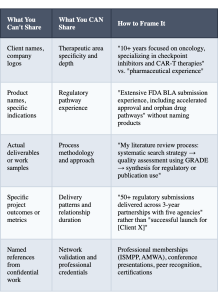
Specific therapeutic knowledge matters more than company name recognition. A freelancer explaining checkpoint inhibitor mechanisms, CAR-T development challenges, or rare disease regulatory pathways demonstrates real capability without naming where that knowledge was applied.
Depth shows in the details: understanding FDA orphan drug designation criteria, or knowing how EMA differs from FDA in conditional approval requirements.
Agencies can probe understanding with questions like “Walk me through your approach to a BLA submission for a cell therapy product” or “What regulatory challenges come up in rare disease indications?” Freelancers who’ve done the work explain the process and approach in granular detail. Those who haven’t speak in generalities. The specificity itself becomes proof without requiring client disclosure.
Process Expertise Over Project Portfolios
How someone structures their work often reveals more than what they’ve produced. Freelancers who articulate their methodology for literature reviews—how they search, evaluate quality, and synthesize findings—demonstrate systematic thinking that predicts performance.
“How do you approach writing different regulatory sections?” generates more signals for agencies than “How many regulatory documents have you written?”
Real experience shows in explanations of draft structures, review cycle management, and timeline planning. Someone who says “typical turnaround for a 20-page clinical overview is 10 to 12 days with two review rounds” demonstrates practical understanding that vague responses can’t match.
Delivery Track Record Over Public Case Studies
Patterns matter more than individual projects when work can’t be shown. Freelancers can share metrics that don’t violate confidentiality: first-draft approval rates, typical revision cycles, relationship duration with agencies. Working with the same three agencies across five years demonstrates consistent delivery that earns repeat business.
Agencies can ask directly: “How many agencies do you work with regularly? How long have those relationships lasted?” Concrete answers like “Delivered 50+ regulatory submissions with average two-week turnaround” or “Maintained ongoing relationships with five agencies, average engagement length three years” provide verification without naming clients.
Network Validation Over Individual References
Professional reputation operates through channels that don’t require client disclosure. For freelancers, membership in organizations like ISMPP, AMWA, or EMWA signals commitment to professional standards. Conference presentations, journal publications, and peer recognition provide validation parallel to confidential client work.
Agencies evaluating specialists can look at professional connections, industry group participation, and ongoing education—continuing medical education credits, certification maintenance, participation in regulatory guidance comment periods. References still matter, just from non-competitive contexts or through intermediaries who can speak to work patterns without disclosing details.
Building Trust Without Compromising Confidentiality
Anonymized proof works when it emphasizes capability indicators over client recognition. Both freelancers presenting expertise and agencies evaluating specialists benefit from frameworks that respect NDAs while establishing trust through verifiable signals.
Verify Expertise Without Compromising Confidentiality
Whether you’re a freelancer looking to demonstrate expertise without violating NDAs, or an agency trying to verify capabilities when portfolios are limited, Talus Freelance bridges the confidentiality trust gap using quality signals that don’t require client disclosure.
References
1. Drange, Matt. “Nondisclosure Agreements Are Now Rampant, Covering Nearly Half of Employees, Study Finds.” Business Insider, 23 Jan. 2025,https://www.businessinsider.com/sign-employee-nda-nondisclosure-agreement-job-study-2025-1.
2. “Background Screening: Trends in the U.S. and Abroad.” Professional Background Screening Association,https://pubs.thepbsa.org/pub/FB36B937-C9D5-A941-7720-4047386F38B0.Accessed 13 Feb. 2026.