





Say an urgent project lands. You need a specialist freelancer fast: a medical writer, a publications expert or someone who can do both. You reach out to your network, post the need, coordinate interviews, and find someone who delivers well. The project wraps, they move on, and the relationship goes quiet. But when the next similar need arises, you start the search over from scratch.
This pattern works until volume or urgency increases. What felt manageable during steady periods becomes the constraint that delays projects and stretches internal teams thin. As freelance resourcing becomes central to how agencies deliver,¹ those who build specialist benches gain speed and consistency advantages that reactive sourcing cannot match.
Why One-Off Sourcing Fails During Peak Cycles
One-off sourcing works until demand spikes. When it does, the same process that seemed efficient becomes the constraint that delays delivery.
Every Search Restarts from Zero
No existing relationships means cold outreach every time. You interview, vet, and check references for each need, even if you’ve worked with someone before on a different project. Because the connection has gone cold, you’re essentially starting fresh.
Research shows reactive hiring leads to significantly longer fill times and higher costs compared to proactive talent pool strategies.² When you need three freelancers simultaneously during a peak cycle, that delay compounds across every role.
Onboarding Friction Compounds During Busy Periods
Each new freelancer needs briefing on your processes, client expectations, and review cycles. This handoff work falls on project managers who are already stretched thin.
Time spent explaining “how we work here” adds up quickly when you need multiple specialists starting at once. Quality often suffers when you rush onboarding to meet timelines, because freelancers don’t have time to absorb your standards before they’re expected to deliver to them.
Quality Becomes Unpredictable Under Pressure
Rushing through vetting to meet urgent deadlines increases mis-hire risk. You don’t know how a freelancer will perform until they’re mid-project, and by then it’s too late to course-correct without missing deadlines. There’s no pattern recognition of what works because every hire is a first-time relationship.
Companies using proactive strategies see stronger retention and better performance because freelancers understand expectations upfront.2 In reactive hiring, you’re making that assessment under time pressure with incomplete information.
How Bench Relationships Accelerate Project Starts
Bench building inverts this dynamic. Instead of sourcing specialists when you need them, you build relationships with proven performers before urgent needs arise.
Proven Specialists Eliminate Sourcing Delays
You already know who’s available in your key therapeutic areas. No posting jobs, screening portfolios, or coordinating interviews. Direct outreach to freelancers who’ve delivered for you before means projects can begin significantly faster than reactive sourcing cycles allow.
Pre-screened talent pools significantly reduce time-to-hire.² When peak demand hits, that speed difference determines whether you meet client timelines or negotiate extensions.
Familiarity With Your Processes Reduces Ramp Time
Freelance specialists in your bench already understand your briefing format, review cycles, and client expectations. They know your therapeutic areas and regulatory context. Less handoff work for project managers means faster starts and better outcomes.
Specialists can begin work with minimal orientation because they’ve navigated your systems before. The project manager’s role shifts from teaching basics to coordinating delivery, which scales better when multiple projects launch simultaneously.
Quality Compounds Through Repeat Engagement
Specialists learn your standards over time, reducing revision cycles. They understand what “good” looks like for your agency and clients without lengthy explanations. Pattern recognition improves; you know their strengths and can match them to appropriate projects with confidence.
Trust builds naturally through proven delivery rather than being assumed through credentials or interviews. Each engagement strengthens the working relationship, making the next project smoother than the last.
Strategic Capacity Planning Becomes Possible
Visibility into who’s available and when enables proactive planning instead of reactive scrambling. You can forecast capacity for peak periods rather than discovering gaps when projects arrive.
Having access to more than one freelance specialist per critical area, rather than relying on a single oncology writer, removes single points of failure when key freelancers are unavailable. This transforms capacity from a constraint you manage project-by-project into a strategic asset you can plan around.
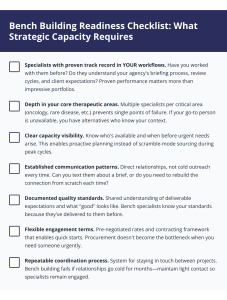
What Strategic Capacity Requires
This shift from reactive sourcing to strategic bench isn’t automatic. It requires specific elements that make relationships repeatable and capacity predictable.
Build Strategic Capacity Without Burning Out Your Team
Building a bench requires maintaining relationships with vetted specialists, tracking availability, and coordinating engagement all while delivering current client work. Most agencies recognize bench building matters but struggle to operationalize it consistently.
Talus handles this coordination for you. We vet, onboard, and maintain relationships with HealthComms specialists across therapeutic areas, track capacity, and match proven performers to your briefs, giving you repeatable specialist relationships that accelerate project starts and improve delivery consistency, without the overhead of managing a bench yourself.
Ready to stop sourcing from scratch? Build a bench that works when you need it most with Talus Freelance. Book a discovery call to start building your bench.
References
1. “Contingent Workforce Management—a Strategic Shift.” Korn Ferry, 10 Aug. 2025,www.kornferry.com/insights/featured-topics/workforce-management/contingent-workforce-management-a-strategic-shift.
2. “Proactive vs Reactive Hiring: Which Strategy Wins Long-Term?” Technology.org, 28 Jan. 2026,www.technology.org/2026/01/28/proactive-vs-reactive-hiring-which-strategy-wins-long-term/.